Indonesian-origin Marvell CEO Dr. Sehat Sutardja
 Dr. Sutardja has incredible foresight into what technologies will power the future devices that will touch people's lives - both on the consumer and enterprise side," said Brian Coleman, president of the SVIPLA (Silicon Valley Intellectual Property Law Association ). "His ability to consistently create new technologies, while running a company that generates annual revenues in excess of two billion dollars, is simply astounding."
Every year the SVIPLA recognizes an individual who has made significant contributions in the technical arts. Dr. Sutardja has consistently driven innovation in the storage, communications and consumer markets by developing technologies which can be creatively shared across numerous systems, ranging from large scale enterprise networks to mass market, consumer electronic devices.
Dr. Sutardja is the inventor/co-inventor of 65 patents with more than 120 patent applications and his technical vision has allowed him to build and grow one of the most successful semiconductor companies in the world. By continuously driving innovation in the semiconductor field Dr. Sutardja provides inspiration to employees, enabling the company to stay on the bleeding edge of technology and ensuring Marvell's continued success. Marvell employees file hundreds of patent applications every year. http://www.marvell.comIndonesian Professionals Association (IPA): http://www.ipanet.org/
Saladin or Salah ad-Din

 Saladin or Salah ad-Din, or Salahuddin Ayyubi (Arabic: صلاح الدين الأيوبي, Kurdish: صلاح الدین ایوبی) (so-lah-hood-din al-aye-yu-be) (c. 1138 - March 4, 1193) was a twelfth century Kurdish Muslim general and warrior from Tikrit, in present day northern Iraq. He founded the Ayyubid dynasty of Egypt, Syria, Yemen, Iraq, Mecca Hejaz and Diyar Bakr.
Saladin is renowned in both the Muslim and Christian worlds for leadership and military prowess, tempered by his chivalry and merciful nature during his war against the Crusaders. Military, politically, and in every other way, Saladin was the most successful leader of the period. Historians convinced that his succeeded in war for a much deeper reason; a reason that won’t seem at first to be related to war at all.
On one occasion, an army scout came to Saladin with a sobbing woman from the enemy camp. She had requested, hysterically, that the scout take her to Saladin. She threw herself before Saladin, and said, ‘Yesterday some Muslim thieves entered my tent and stole my little girl. I cried all through the night, believing I would never see her again. But our commanders told me that you, the king of Muslims, are merciful.’ She begged for his help. Saladin was moved to tears. He immediately sent one of his men to the slave market to look for the girl. They located her within the hour and returned her to her mother, whom they then escorted back to the enemy camp.
Saladin united all the Muslim peoples from Syria to Egypt and mobilized their collective resistance. His army recaptured Jerusalem in 1187. In the spring of 1187, after the Crusaders had broken a truce, Saladin called upon the forces of Islam to gather in Damascus. He planned to march against the occupiers in a unified effort and drive them from Jerusalem.
Saladin sprung a trap on the occupying – err, rather, Western – forces near the Sea of Galilee. A few escaped, including a leader named Balian of Ibelin. Balian escaped to Tyre, where via a messenger he made a surprising request of Saladin: he asked whether he could go to Jerusalem and fetch his wife and bring her back to safety in Tyre. He promised he would not take up arms in defense of Jerusalem. Saladin agreed.
However, upon arriving in Jerusalem and finding there was no one to lead its defense, Balian begged Saladin to let him out of his commitment. He wanted to stay and lead the resistance against Saladin’s army. Saladin not only allowed it, he sent an escort to lead Balian’s wife from Jerusalem to the safety of Tyre!
If you were to research Saladin, you would discover that this story is characteristic. He was renowned for his kindness toward allies and enemies alike. Despite his fierce struggle to the Christian incursion, Saladin achieved a great reputation in Europe as a chivalrous knight, so much so that there existed by the fourteenth century an epic poem about his exploits, and Dante included him among the virtuous pagan souls in Limbo. The noble Saladin appears in a sympathetic light in Sir Walter Scott's The Talisman (1825). According to The French Writer Rene Grousse: "It is equally true that his generosity, his piety, devoid of fanaticism, that flower of liberality and courtesy which had been the model of our old chroniclers, won him no less popularity in Frankish Syria than in the lands of Islam."
The siege of Jerusalem began on the twentieth of September 1187. Nine days later, Saladin’s men breached the wall close to the place where the Crusaders had flowed through almost ninety years earlier. Saladin put his men under strict order not to harm a single Christian person or plunder any of their possessions. He reinforced the guards at Christian places of worship and announced that the defeated peoples would be welcome to Jerusalem on pilgrimage whenever they liked.
Despite the Crusaders' slaughter when they originally conquered Jerusalem in 1099, Saladin granted amnesty and free passage to all common Catholics and even to the defeated Christian army, as long as they were able to pay the aforementioned ransom (the Greek Orthodox Christians were treated even better, because they often opposed the western Crusaders).
As a way to restock the treasury, Saladin worked out a ransom structure with Balian for each of the city’s inhabitants. His men protested that the amount were absurdly low. But Saladin was concerned for the poor among them. So much so, in fact, that he let many leave without any ransom whatsoever. He sent widows and children away with gifts. His leaders objected, saying that if they were going to let so many leave without any compensation, they should at least increase the ransom for the wealthy. But Saladin refused. Balian himself was allowed to leave with a rich sum. Saladin even sent an escort to protect him on his journey to Tyre.
He sounds for most people disturbingly weak. Yes, so weak that he was the most successful military leader of his era and remains revered to this day. But he wasn’t weak. He was, in fact, remarkably and unfailingly strong. But he was something more than – or perhaps more accurately deeper than – strong. And this extra something is what set him apart from all the others of his era who, although strong, were unsuccessful. The secret of Saladin’s success in war was that his heart was at peace. And not just in war. It is the secret to success in business and family life as well. The state of your heart toward your children – weather at peace or at war – is by far the most important factor in the success of raising your children. It is also what will most determine your ability to successfully maneuver your company through the challenging times.
Abraham Lincoln
Abraham Lincoln, February 5, 1865. The weariness in the portrait reveals how much the overwork and anxiety of four years war had cost Lincoln.


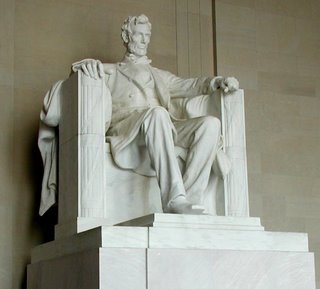
He likes to describe himself as an ordinary man who made the most of himself. As a young man, he was anything but refined. But all that changed with the time, and the beauty of the Lincoln story is watching him grow in depth of his character. Lincoln became a genuine hero, something greater than being rich, famous, or powerful. His heroism involved sacrifice, generosity, bravery, and a vision that would transform America. He recognized the great power of words, which can produce light in the most unlikely places. The words of the Declaration of Independence, written by a man he considered his spiritual father – Thomas Jefferson, defined Lincoln, stirred him, and helped make him who he was. He gradually became a master of words himself. In fact, no American President has ever used words more effectively. Years later, when he was invited to the dedication of the military cemetery at Gettysburg, he included an excerpt from the Declaration of Independence in his famous address when he reaffirmed that all men are created equal.
Arie de Geus
 Arie de Geus joined Royal Dutch/Shell in 1951 and remained with the company for 38 years. He worked in Turkey, Belgium, and Brazil before returning to the United Kingdom in 1979. Arie assumed regional responsibility for Shell's businesses in Africa and South Asia and then, in 1981, became coordinator for Group Planning. During his last 10 years at Shell, Arie became increasingly interested in the nature of large corporations, their decision-making processes, and the management of change and he is widely credited with originating the concept of the learning organization.
Since his retirement from Shell in 1989, Arie has headed an advisory group to the World Bank and consults with government and private institutions. He is a visiting fellow at London Business School, and a board member of the Nijenrode Learning Centre in the Netherlands.
Andy Grove
 TEACHER OR STUDENT? Andy Grove switches roles readily
It’s not common for any CEO to stand before an audience and say, “I don’t know what to do. What do you think?” It’s even less common for the CEO to listen to the response and take them seriously. But Andy Grove has never lost track of the truth: that Intel has always been one wrong answer away from disaster – and that a closed mind is a trap door to the abyss.
At Intel he fostered a culture in which “knowledge power” would trump “position power.” Anyone could challenge anyone else’s idea, so long as it was about the idea and not the person – and so long as you were ready for the demand “Prove it.”
During Andy Grove’s 11-year tenure as CEO, Intel grew at a compound annual growth rate of nearly 30 percent. What made such extraordinary growth possible under his leadership was his continuing ability to adapt to shifting realities. When reality has changed, he has found the will to let go and embrace the new. Andy Grove is the greatest student and teacher of business.
As the chairman and former CEO of Intel, the world's largest semiconductor manufacturer, Andy Grove has been a brilliant business strategist. Harvard professor Richard S. Tedlow says, "Intel's legendary chief Andy Grove is the best model we have for leading a business in the 21st century."
Intel CEO Craig Barret and Applied Materials CEO Mike Splinter
 Intel CEO Craig Barret and Applied Materials CEO Mike Splinter, at the Intel ISEF opening ceremonies at the Oregon Convention Center, Portland, Ore.
Andy Grove, during his keynote
 Andy Grove, during his keynote titled "Taking a Random Walk," at Intel International Science and Engineering Fair
Andy Grove with Nelson Moussazadeh
 Andy Grove with Nelson Moussazadeh, 17 (Great Neck, NY) -- Induction of Cardiomyocyte Differentiation Following Stimulation
Andy Grove with Hans Christiansen Lee
 Andy Grove with Hans Christiansen Lee, 18 (Monterey, CA) -- NGC: A New Paradigm for Computer Architecture
Andy Grove with Francis Boulva
 Andy Grove with Francis Boulva, 18 (Montreal, Canada) -- Galactic Champagne
Andy Grove with Yash Vasant Joshi
 Andy Grove with Yash Vasant Joshi, 14 (Mumbai, Maharashtra, India) -- Reprocessing of Plastic Wastes at Place of Generation
Andy Grove with Mariangela Lisanti
 Andy Grove with Mariangela Lisanti, 17 (Westport, Conn.) -- Conductance Quantization in Au Nanocontacts
Andy Grove with Ramon Hegedus
 Andy Grove with Ramon Hegedus, 19 (Szombathely, Hungary) -- Three-Dimensional Fast Photography of Excimer Laser Ablation
The Native Spirit Singers and Dancers
 The Intel Science and Engineering Fair kicked off with a performance by the Native Spirit Singers and Dancers.


 Dr. Sutardja has incredible foresight into what technologies will power the future devices that will touch people's lives - both on the consumer and enterprise side," said Brian Coleman, president of the SVIPLA (Silicon Valley Intellectual Property Law Association ). "His ability to consistently create new technologies, while running a company that generates annual revenues in excess of two billion dollars, is simply astounding."
 Saladin or Salah ad-Din, or Salahuddin Ayyubi (Arabic: صلاح الدين الأيوبي, Kurdish: صلاح الدین ایوبی) (so-lah-hood-din al-aye-yu-be) (c. 1138 - March 4, 1193) was a twelfth century Kurdish Muslim general and warrior from Tikrit, in present day northern Iraq. He founded the Ayyubid dynasty of Egypt, Syria, Yemen, Iraq, Mecca Hejaz and Diyar Bakr.


